Finally, could this be the dawn of the Age of Dupont-Jalibert for France rugby?
It has been a long time coming, but the 2026 Six Nations could be finally see France’s long desired scrum-half, fly-half partnership start to realise its immense potential

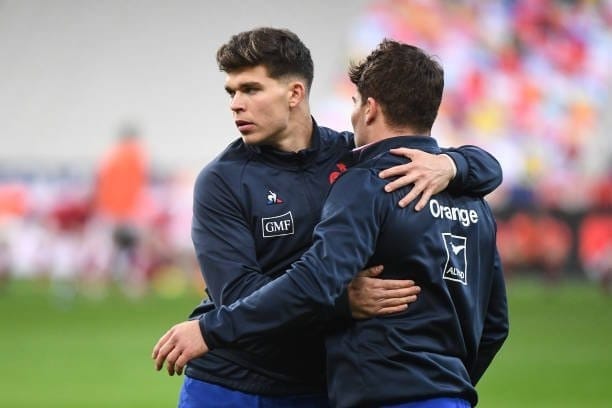
Romain Ntamack’s injury bursts open the door — again — on the prospect of a long-desired French halfback partnership to rule them all, and concerns that — again — an Antoine Dupont-Matthieu Jalibert hinge will fall short of the great expectations placed on it. This time, however, there’s real cause for optimism
It is one of the great mysteries of the current French rugby era: how can two of the best players of their generation conspire to be less than the sum of their parts?
Antoine Dupont and Matthieu Jalibert should form a halfback partnership that strikes le terror into the hearts of even the best opponents at the very top of their game.
Yet what actually happens on the pitch, the one metric that actually matters, they just haven’t clicked.
Dupont’s tendency to play around the rucks hinders Jalibert’s preference for space. Their styles have not dovetailed anywhere near as well as Dupont-Ntamack, or Dupont-Ramos. The result, a weakness at the joint and a clear wobble everywhere else.
Even with Maxime Lucu, his halfback partner at club level, Jalibert has laboured at international level.
This is both, as Pau scrum-half Dan Robson suggested on the Rosbifs Rugby podcast recently, a problem of the players’ making, in their inability to adapt better to one another, as well as the coaches’ very French ‘we tried’ shrug-and-move-on attitude.
Fabien Galthie can point to the number of times he’s selected Jalibert as evidence of his desire to see the Bordeaux 10 play at the highest level, and international coaching periods are short, hard and intense, with little time for personnel issues. But some players — surely, of all of them, this one — would be worth extra effort.
Jalibert’s form this season has been such that his name should, must, probably would be the second inked on Les Bleus’ teamsheet, after that of Dupont, even if Romain Ntamack was fit. His past with France, with Dupont, is such that Galthie may still hesitate a fraction of a moment before adding it.
The question that Galthie has to ask is not the same one the rest of us want him to. He’s not looking for the best player in France, necessarily, as much as he is the best player for France. So far, and with demonstrable reason — just look at the win sheet, particularly the one with Dupont’s name included — Galthie has generally opted for Ntamack.
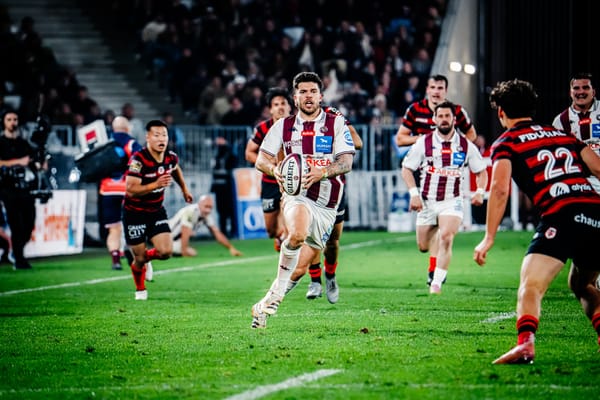
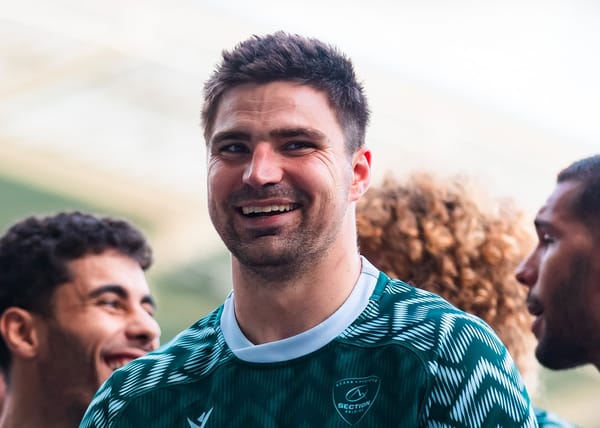
But form is impossible to ignore. Scintillating is an insufficient adjective to describe many of Jalibert’s performances this season, domestically and in the Champions Cup.
The data tells an astonishing story. He’s beaten more defenders in the Top 14 than anyone else, and has more line breaks than any player other than Clermont’s Harry Plummer. And as for the highlight reels, well… it got L’Equipe wondering pointlessly whether we might see a return of the Dupont-Jalibert-Ntamack triumverate.
But he’s developed in previously unexpected ways over the past couple of seasons, and particularly in the last 12 months, during which Bordeaux won their first Champions Cup. A lot.
His work behind the scenes with former rugby league player Aurélien Cologni has led to a marked improvement in his defensive work. He’s still not as solid as Ntamack, but the gap is closing.
But that’s not been his greatest transformation. That has come in the quieter moments — the grey phases, to steal a phrase from Castres’ defence coach Steven Setephano — when the game seemingly drifts a little, when fewer eyes are paying attention because nothing special is going on, where Jalibert’s progress as a player has been the most impressively marked.
And this is the point. Once upon a time, not so very long ago, a visibly agitated Jalibert would strut and fret these periods, and try to impose his sound and fury on a game — or even just a set — that wasn’t ready for it.
In an interview with L’Equipe in September, Jalibert said: “I’ve found my place, the pleasure of managing the game and taking on responsibilities. It’s a good balance.
“Previously, my game was a little more focused on attacking the line, looking for individual solutions, even though I never played [for individual accolades].”
He added: “With the backline we have, it's a joy to be in the middle and put them in better positions. It’s the evolution of my game and my physical condition, maturity in my position, the realisation that you can’t play 31 matches a year attacking every ball.”
It’s a mental gestalt shift that, as gestalt shifts do, changes everything. And he’s not just talking the talk. He’s walking the walk, too. So far this season, I can recall just one game, Bordeaux’s defeat at home to Pau, in which he tried to force moments that didn’t need forcing.
The greatest trick that Ntamack ever pulled at fly-half for France and Toulouse was patience, of managing the game from the shadows. He’s long made a virtue of being barely noticeable, until he suddenly is. It’s a style of play that works handsomely when France work, less so when France fail — he played pretty well in the November internationals, but copped more than his fair share of flak because Les Bleus, on the whole, didn’t.
Irish fans probably won’t be pleased to read this but Bordeaux attack coach Noel McNamara as well as club and country halfback partner Maxime Lucu both deserve a huge amount of the credit for bringing out the hidden Ntamack in Jalibert.
None of which is to suggest that Jalibert is now about to start playing like Ntamack. Far from it. He couldn’t if he tried, and why would he even want to try?
But a more efficient Jalibert, capable of managing a game and complementing Dupont as French fans have long hoped he could? That would get France fans cheering.